
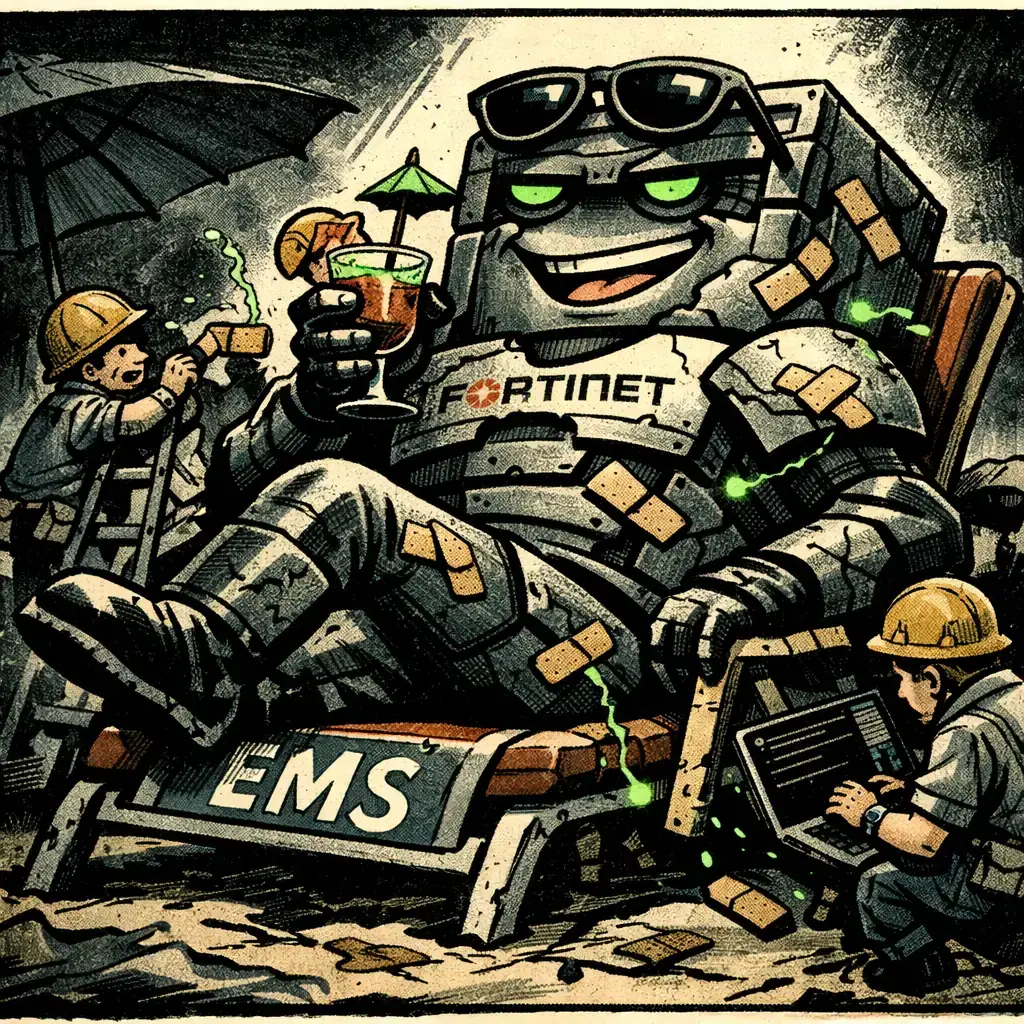
The images in this article were generated with artificial intelligence. How we publish
The security community is on the alert after confirmation of the active exploitation of critical vulnerability on the endpoints management platform of Fortinet, FortiClient EMS. Identified as CVE-2026-21643, it is a SQL injection that, in unpatched systems, allows malicious actors to run commands or code remotely with a low level of complexity.
Researchers of the Defused intelligence firm publicly alerted to the first attempts at exploitation, explaining that the attackers introduce malicious SQL instructions into the "Site" header of HTTP requests addressed to the FortiClient EMS web interface. You can see your warning directly in your online public release Here.. This vector is particularly dangerous because it does not require prior authentication to try to exploit the failure.

Fortinet internally detected the failure and attributed it to a specific version of the product: the facilities with FortiClient EMS 7.4.4 are those affected. The technical mitigation recommended by the manufacturer itself is to update to version 7.4.5 or higher; the official safety note is available on the FortiGuard portal de Fortinet. Meanwhile, some press reports tried to confirm with the company the holdings observed, without any immediate response.
The potential scope of the problem is increased by the Internet exposure of many EMS servers. The Shadowserver surveillance group tracks over 2,000 FortiClient EMS instances with the Internet-accessible web interface, largely spread between the United States and Europe; its public follow-up panel is located Here.. An additional tracking with Shodan returns hundreds or thousands of publicly identifiable instances, which facilitates the work of actors seeking vulnerable objectives ( Search in Shodan).
This episode fits a known pattern: the weaknesses in Fortinet products have been the usual target of Ransomware campaigns and espionage operations, often exploited very quickly. The US Agency for Infrastructure and Cybersecurity. USA (CISA) has previously identified Fortinet vulnerabilities as exploited in practice and has ordered urgent patches for federal environments on previous occasions; you can see the catalogue of vulnerabilities known to CISA in this link, and historical searches on failures related to FortiClient EMS in particular Here..
If you administer FortiClient EMS, the recommendation is not only theoretical: it acts immediately. First, make the update to the secure version (7.4.5 or higher) as soon as possible. In parallel, if you cannot park immediately, it limits access to the management interface: it blocks direct traffic from the Internet, forces access by VPN or by access control lists that allow only reliable management PIs, and considers submitting a WAF or perimeter inspection rules that filter suspicious requests to the HTTP header using the explosion.
In addition to the patch and access containment, it is appropriate to start detection and response work: review the web interface and server records to search for abnormal requests that include data in the "Site" header, search for unusual activity in databases or EMS server processes, and expand monitoring with EDR / IDS to detect unauthorised command execution. If there are signs of commitment, isolate the instance, perform forensic analysis and restore systems from clean copies; do not forget to change administrative credentials and rotate credentials from exposed services.
Finally, note that speed is key. Management vulnerabilities, by their nature, allow rapid side movements within corporate networks and facilitate the delivery of harmful loads such as ansomware. If your organization uses FortiClient EMS, treat this alert as a priority and coordinate patch, access restrictions and detection activities without delay. For technical information and official updates see the CVE tab in the NVD Here., the public notice of Fortinet in FortiGuard Here. and the following reports of exhibitions in Shadowserver and Shodan mentioned above.

FBI and six countries link Integrity Technology Group to entity post theft in SE Asia
On October 8, the FBI and agencies in six countries issued a joint warning that assigns to a Chinese company, Integrity Technology Group, a sustained series of intrusions whose ...

Campaign with LLM and ARTEX attacks South Korean financial institutions and exfilters data
Security researchers have documented a campaign directed against South Korean financial institutions using language-driven attack tools to automate intrusions and data extractio...

ChainDrop campaign exposes tensorlake in npm; version 0.5.144 withdrawal
A package of npm called tensorlake, an SDK in TypeScript oriented to Tensorlake applications and services, was engaged in a supply chain campaign linked to the attack family kno...

Google reports DNS kidnapping: TLS certificates for google.com.gh, google.sl and google.as
Google reported on October 6 that attackers managed to issue unauthorized HTTPS certificates for Google and YouTube names after compromising authoritative DNS records of three t...

Cyber risk in 2026 moves to workflows and IA, according to Voice of the CISO
The data added by five editions of the Voice of the CISO study - including the most recent findings of 2026 - draw a less intense change than risk location: the threat is moving...

Phishing BitB points to advertising professionals and account managers to steal MFA
Security researchers have described a phishing campaign for advertising professionals and account managers that uses a human-operated platform to mimic ad products linked to IA ...