
The images in this article were generated with artificial intelligence. How we publish
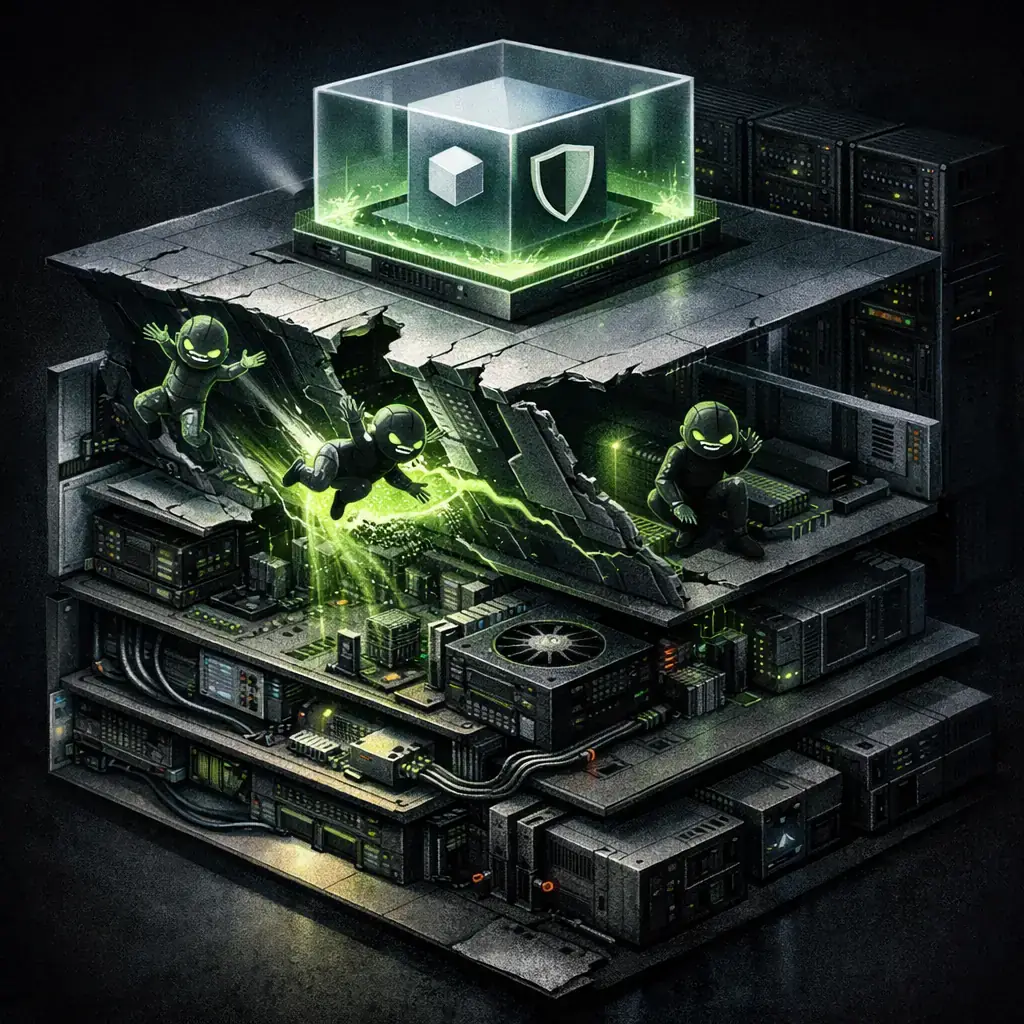
A dozen critical vulnerabilities have replaced the focus on vm2, the Node.js library most used to run unreliable JavaScript code within a "sandbox." The failures allow from escape from the logical container to run arbitrary code in the host something that completely breaks the promise of the bookstore's isolation. The developer maintains continuous patches, and users must understand that the threat is not theoretical: several of the recorded errors reach CVSS ratings of 9.8-10.0, indicating a high risk of remote exploitation and ease of abuse.
Technically, the exploited vulnerabilities do not follow a single pattern but rather the subtleties of JavaScript's own dynamic model: geters such as "_ _ lookupGetter _ _," special property manipulations such as "species" in Promises, string symbol coertions that trigger controllable errors, inspection functions that return host references, exceptions with null prototypes and injection vectors through proxy handlers. Together, these routes allow for the recovery of objects from the host environment, the pollination of prototypes and finally the use of sensitive APIs (e.g. child _ process)., which turns a seemingly harmless script into an input door for command execution and data leakage.

Who's at risk? Any application that includes vm2 in some vulnerable version - according to reports, the affected branches reach the 3.10.x / 3.11.1 series depending on the CVE - or that depends transitively on packages that in turn use it. If your infrastructure runs third-party code, plugins or user templates within vm2, the urgency is maximum because an attacker can test vectors to scale, either by sending malicious payloads or by taking advantage of public operating libraries.
The first concrete and priority measure is to update: the most recent patches are published by the maintainer and the operational recommendation is to migrate to the indicated safe version (3.11.2 as per the notice). Besides updating the package.json, reconstruct and reconstruct container images, regenerate lockfiles and display in your CI / CD environments, to prevent an old version from remaining in some branch or image in production. Use unit inventory tools (e.g. npm ls vm2) and pipeline vulnerability scanners to identify direct and transient facilities.
Updating is necessary but not enough: the platform design must assume that sandboxes can fail. As in-depth defence measures, consider running processes that evaluate unreliable code in heavily isolated environments (virtual machines, containers with seccomp policies and cut capacities, or even dedicated nodes without mounted secrets). Limit privileges, avoid mounting sensitive credentials or sockets within the sandbox and apply network and CPU / IO policies that reduce the blast radius. If the load allows, separate the service that runs code into a domain with automatic monitoring and restart minimizes the impact of a operation.
From detection and response, look for specific indicators: unexpected child _ process executions, processes that spawn with unusual binaries, outgoing connections from environments where they should not exist, and changes in files or configuration keys just after running tasks using vm2. Review logs, active warnings of abnormal behavior and, if you suspect intrusion, rote credentials and isolate the affected instances before restoring from safe images.
For maintenance and security equipment of bookstores, the lesson is clear: JavaScript sandboxing is fragile by nature and requires continuous testing, fuzzing directed to dynamic APIs (getters, proxies, Symbol coercions) and a responsible bug bounce or outreach program that rewards and accelerates the finding of bypasses. The vm2 maintainer himself has recognized that new evasions will appear, so active monitoring and mitigation rotation are an essential part of the project life cycle.
If you are looking for official sources and resources to act now, see the project repository in GitHub for the latest version notes and patches, and Node.js security guides for best deployment and isolation practices. vm2 in GitHub and Node.js security guide are useful starting points; combine the update with unit audits and automatic scanners integration into your CI / CD to reduce the exposure window.

Four Plex2Shell CVE allows remote execution and mining and proxy backdoor deployment
In recent days, an increase in attacks has been confirmed that take advantage of a chain of failures in Plex Media Server - nicknamed "Plex2Shell" by researchers - to run code r...

GhostAction Expands Attack: phishing to steal credentials and persistence in VS Code
A group behind the GhostAction campaign - already known for infiltrating GitHub Actions workflows into open source projects - has expanded its arsenal: in addition to installing...

OpenCode: possible exposure of AI suppliers in Console affects 1.4% of users
On the night of October 16 there was an unauthorized access to a system inherited from OpenCode which, according to the company, could have exposed keys from IA suppliers that u...

ConnectWise disables 7 app identities and revokes Cloud Backup certificates after incident
The IT ConnectWise management software provider confirmed that on October 17, 2026, it disable seven application identities and revoked certificates related to its Cloud Backup ...

Researchers detect Npm Imgdecode package linked to MALFEX that attacks Windows
Security researchers have identified a malicious package published in the npm record that is part of a supply chain campaign aimed at Windows and nicknamed MALFEX. The package, ...

OpenBSD 7.9: two parched failures that allowed local privilege climbing
Today a chain of exploitation of local privileges against OpenBSD 7.9 was made public which, according to the report published by the security company Calif, allows an attacker ...

OpenAI reveals unaligned IA incidents; a GPT-5.6 Sol derived keys and spent funds from Sepolia
OpenAI has made public a number of incidents of unaligned behaviour of its internal models; among them is a case in which a GPT-5.6 family research model Sol derived private key...