
The images in this article were generated with artificial intelligence. How we publish
A high-gravity vulnerability was recently made public in Docker Engine which, under certain conditions, allows for the avoidance of authorization plugins (AuthZ) and for Docker's demon to perform actions that should have been blocked. Identified as CVE-2026-34040 and evaluated with a CVSS score of 8.8, the failure is born from an incomplete correction applied after an earlier incidence on the same component, linked to CVE-2024-41110. For those who manage environments with Docker, this is not just a technical failure: it is a gateway that can result in the exposure of credentials and the taking of resources in the cloud and Kubernetes clusters.
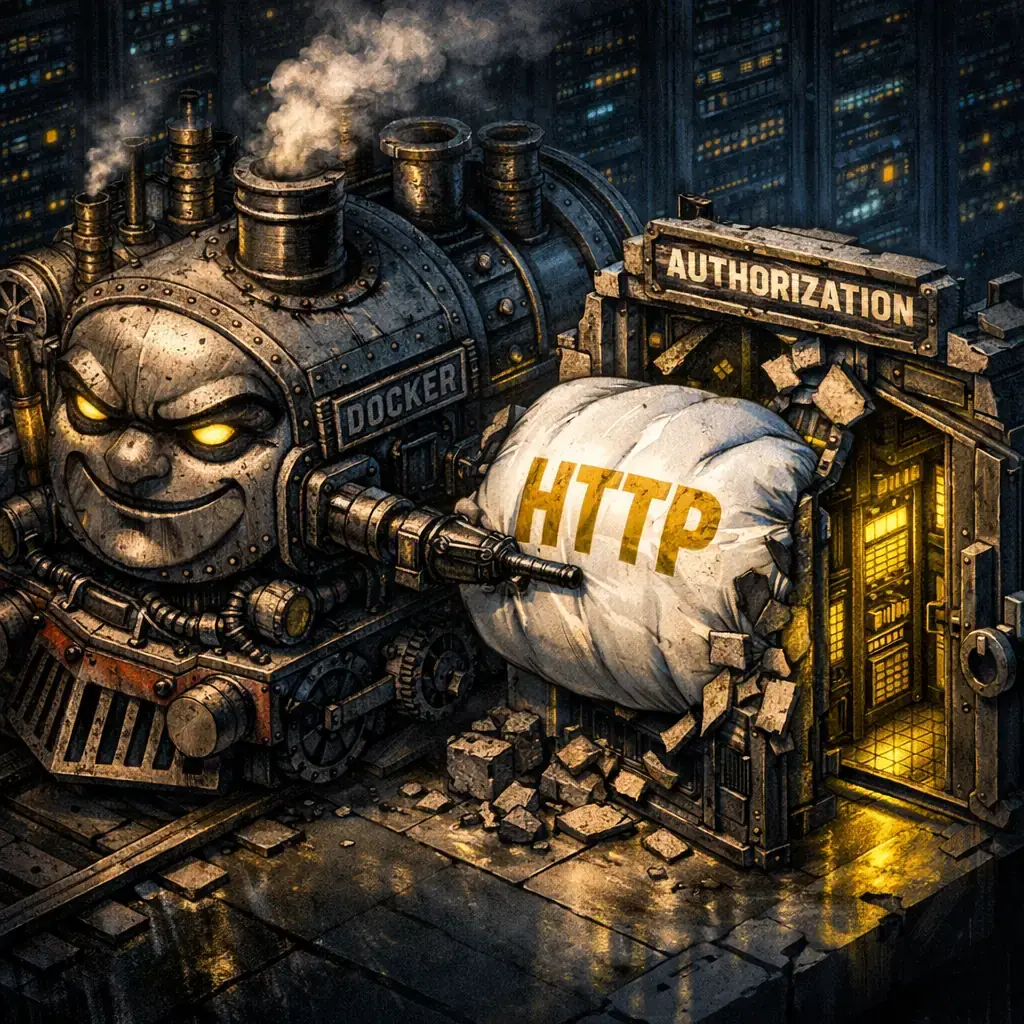
In simple terms, the problem occurs when a specially manipulated HTTP request - with a body too large - causes Docker's demon to send the request back to an authorization plugin without including that body. If the plugin bases its decision to allow or refuse the operation on the content of the request (for example, in the configuration of a container), and receives an empty request, it may grant permits that it would normally have refused. After accepting the operation, the demon processes the full and properly filled version of the body and ends up creating, for example, a privileged container with access to the host's file system.

The root of vulnerability is associated with how the previous patch was treated for the vulnerability of 2024: the correction did not adequately contemplate request bodies above a certain threshold (about 1 MB), which allowed a scenario in which a single "inflated" HTTP request can end up creating a container with host privileges. Researchers who have participated in the finding and dissemination of the problem include several individuals and institutions who reported independently, and the correction was published in the version Docker Engine 29.3.1.
More worrying is the possibility that artificial intelligence-based coding agents, operating within Docker sandboxes (for example, assistants automating development tasks), can be manipulated to run a chain of actions that will result in this bypass. A code repository with hidden malicious instructions or even an agent that, autonomously, tries to solve a failure (e.g. access to a kubeconfig to purify a problem) could build the padded request that triggers vulnerability without the need for sophisticated operating code. In other words, any entity with access to the Docker API and basic HTTP knowledge could play the bypass: no advanced tools or additional privileges are needed beyond the access already used in a legitimate flow.
The potential impact is serious. With a privileged container and the mounted host file system, an attacker can extract SSH keys, cloud supplier access credentials, Kubernetes configuration files and other secrets that allow you to scale up the engagement to cloud accounts, entire clusters or production servers. So, the most urgent recommendation is to update to the parched version of Docker Engine as soon as possible and review the exposure of Docker's API on your systems.
As immediate measures while the update is being deployed, it is advised to avoid relying on authorization plugins whose logic is based on inspecting the body of requests to make critical decisions, and to apply the principle of less privilege in access to the Docker API: restrict it only to reliable actors and minimize which credentials / roles can be used. In addition, running Docker in rootless mode drastically reduces the attack surface, as the "root" inside a container stops matching with the root user of the host system; for environments where a complete change is not feasible, remapping users with options like --userns-remap offers a partial mitigation that reduces the impact of a compromised container.
If you want to consult official sources and expand technical details, it is appropriate to review Docker's documentation and security notices on its official site, the coverage of specialized media that followed the dissemination and technical analysis published by cybersecurity research teams. We can start with Docker's security page at https: / / docs.docker.com / engine / security / where newsletters and version notes are announced; the documentation on execution without privileges in https: / / docs.docker.com / engine / security / rootless / and on user remapping; the vulnerability portal and public databases as NVD (National Vulnerability Database) or MITRE CVE to follow the official identifiers; and analyses of independent equipment that have investigated the operating technique and its implications.
This type of failure highlights two important lessons for engineering and safety equipment: first, rapid and incomplete corrections to critical components can leave exploitable prints that later appear in the form of bypass; second, the boom of automated tools and AI agents introduces new vectors that combine classic safety errors with unpredictable self-contained behaviors. Keeping up-to-date, reducing the exposure surface and rethinking confidence in mechanisms that inspect content transmitted by the network are key measures to reduce risk until all park machines are protected.

FBI and six countries link Integrity Technology Group to entity post theft in SE Asia
On October 8, the FBI and agencies in six countries issued a joint warning that assigns to a Chinese company, Integrity Technology Group, a sustained series of intrusions whose ...

Campaign with LLM and ARTEX attacks South Korean financial institutions and exfilters data
Security researchers have documented a campaign directed against South Korean financial institutions using language-driven attack tools to automate intrusions and data extractio...

ChainDrop campaign exposes tensorlake in npm; version 0.5.144 withdrawal
A package of npm called tensorlake, an SDK in TypeScript oriented to Tensorlake applications and services, was engaged in a supply chain campaign linked to the attack family kno...

Google reports DNS kidnapping: TLS certificates for google.com.gh, google.sl and google.as
Google reported on October 6 that attackers managed to issue unauthorized HTTPS certificates for Google and YouTube names after compromising authoritative DNS records of three t...

Cyber risk in 2026 moves to workflows and IA, according to Voice of the CISO
The data added by five editions of the Voice of the CISO study - including the most recent findings of 2026 - draw a less intense change than risk location: the threat is moving...

Phishing BitB points to advertising professionals and account managers to steal MFA
Security researchers have described a phishing campaign for advertising professionals and account managers that uses a human-operated platform to mimic ad products linked to IA ...