
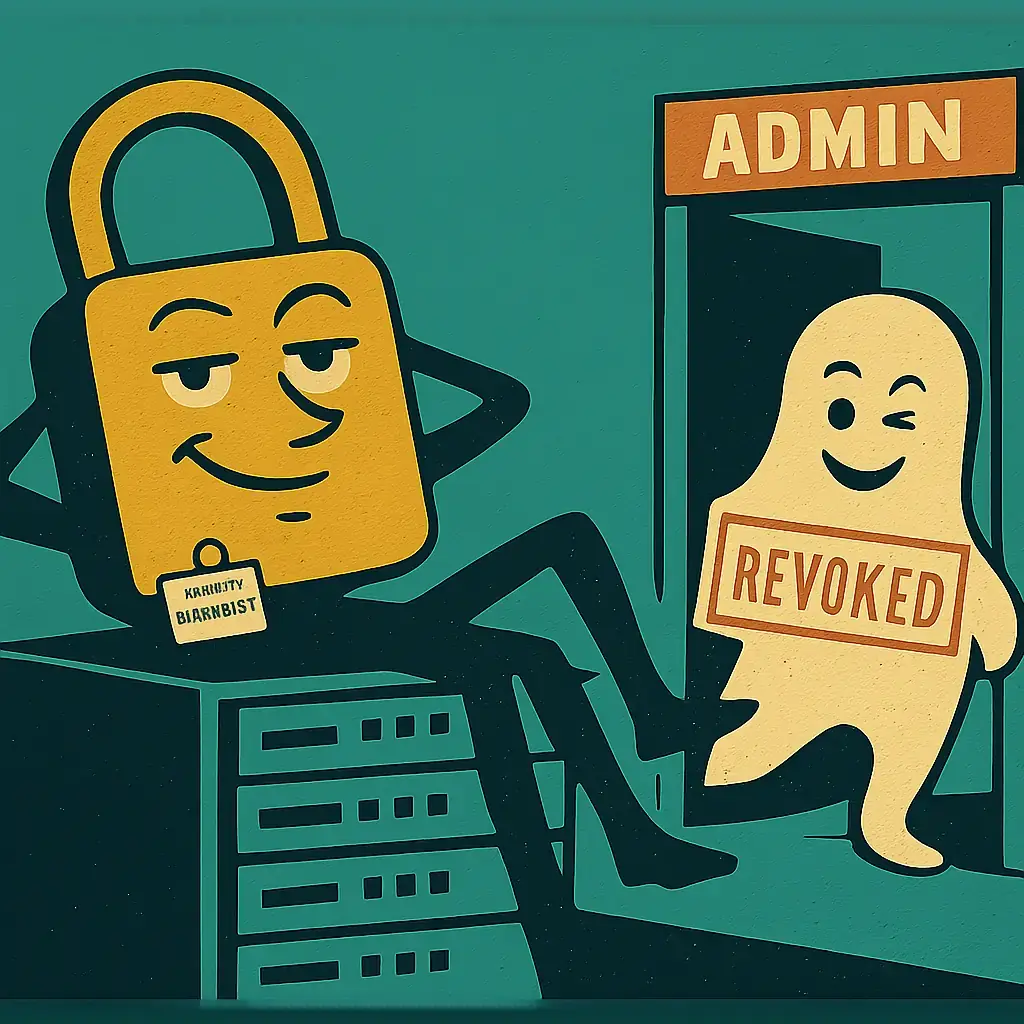
The images in this article were generated with artificial intelligence. How we publish
An error in the implementation of the GoAhead embedded server TLS allows the revoked customer certificates to continue to be authenticated in certain settings. EmbedThis, the developer of GoAhead, published the correction in version 6.1.1; the researcher Sébastien Féry of FoxIO described the failure and two other related weaknesses in a public report at the end of October. The main vulnerability, identified by the supplier as CVE-2026-115881 and valued by EmbedThis with score 9.1, affects built-in building using the OpenSSL backend with mutual authentication TLS (mTLS) when a certificate revocation list (CRL) is set up: the list is loaded in the boot, but the server does not activate the revocation check, so a certificate that appears as revoked can complete the handshake and get access.
How it works technically: in a mTLS installation the server must validate both the customer's certificate chain and its status of revocation (CRL or OCSP). In GoAhead's problem compilations linked to OpenSSL, the code loads the CRL file at the start and does not produce error, but does not invoke the revocation check during the customer certificate verification process. In FoxIO's public tests against GoAhead 6.1.0 with OpenSSL 3.6.2, a certificate marked as revoked was accepted when the issue (issuer) check was activated; OpenSSL described the behavior as that the revoked certificates are "quietly accepted." That's why an operator can believe that the revocation works - the CRL was loaded without a fault - when it's not actually being applied.
Conditions necessary to exploit the failure (confirmed): The firmware build must use the OpenSSL backend; the server must require customer certificates (mTLS); there must be a bundle of trust certification authorities and the issue check must be activated; in addition, a CRL file including the victim certificate must have been configured. The attacker needs to have a certificate signed by a trusted authority that also appears in the CRL as revoked. The buildings using the Mbed TLS backend are not affected by this particular failure, because that backend does the check on a different code route.
Realistic impact: a device with the affected configuration would allow a client whose certificate has been revoked (e.g. by loss or withdrawal of a device) to continue to access the management pages or the apparatus management API with the same permissions as when the certificate was valid. In industrial environments or managed networks, this can result in unauthorized access to router management functions, printers, gateways and industrial controllers. EmbedThis states that GoAhead is integrated into hundreds of millions of devices, but there is no public confirmation of how many devices exactly run a combination of backend and vulnerable options.
Information confirmed against unknowns: it is a verified fact that EmbedThis released the correction in GoAhead 6.1.1 (available for manufacturers on August 2 and published on October 12) and that FoxIO published evidence of concept and analysis. It is also confirmed that vulnerability requires a combination of active options when compiling firmware (OpenSSL + mTLS + CRL configured + issue checking). What is still not publicly confirmed is the actual extent of deployment of vulnerable buildings, if specific manufacturers have distributed affected firmware to customers, and if the failure has been exploited in the field; to date of the report there is no public evidence of active exploitation. EmbedThis has requested that the public entry of the CVE be allocated and, according to the supplier, some entries are not yet on the public bases (status verified as at 27 October according to the supplier's note).
In addition to the omitted revocation check, the FoxIO report documents two additional failures that depend on the backend and compilation options: one related to key exchanges that allow you to deduct the key if the client accepts too small parameters (this does not affect TLS 1.3 or ECDLE and has been mitigated in Mbed TLS 4.x) and another that allows you to complete authentication by presenting a chain of certificates longer than the internal limit when GoAhead is linked against certain old versions of LibreSSL. It is important to understand that each of these problems manifests itself only with specific combinations of backend and configuration, chosen in firmware compilation time; from the network it is not always possible to distinguish which backend uses a device.
What device managers and owners should do (concrete and priority actions): first, check if new firmware 6.1.1 or later is available for your equipment and apply the updates provided by the manufacturer as soon as they are verified. EmbedThis recommends, after updating, completing active sessions, reboot the server and change passwords that were stored with the new Blowfish format introduced in 6.1.0 - the same version introduced a vulnerability of login bypass in some types of build that is also corrected in 6.1.1.
If you cannot update immediately, take mitigating measures: disable mTLS in the affected interface if feasible and replace authentication with alternative methods that do not depend on CRL verification; limit access to management interfaces to separate management networks (VPN or VLAN), firewalls or access control lists; revoke and reissue certificates that suspect committed and remove any lost or no longer used certificates; and audit login to detect login that match revoked credentials. In addition, consider rotating CA keys and client certificates if there is a high risk of commitment. For industrial or critical environments, ask the supplier for explicit confirmation of the used backend (OpenSSL vs Mbed TLS vs LibreSSL) and whether the installed firmware incorporates the correction.

Tools and tracking: FoxIO has published concept tests and offers prints to detect GoAhead building by backend through its JA4Scan tool; that fingerprint identifies the build, does not confirm that the server is vulnerable in production. Also review official sources for ads and patches: the GoAhead project page in EmbedThis and the manufacturer's security communications are the channels for receiving updates. To understand the technical implications of revocation lists and mTLS, OpenSSL documentation and CVE repositories are useful resources.
Liaison to official and useful resources: information about GoAhead and updates on the supplier's site: https: / / embedthis.com / goahead /. For context on OpenSSL and general operation of TLS revocation: https: / / www.openssl.org /. Find information about the CVE identifier in the public database: https: / / cve.mitre.org /.
Conclusion: Vulnerability is not an accidental configuration failure of the administrator but a defect in the code and backend combination that makes a critical security check not run even if the CRL appears to be loaded properly. The final mitigation is to apply GoAhead 6.1.1 when the equipment manufacturer delivers it; until then, reducing the exposure of management interfaces and rotating certificates are the practical measures that reduce the immediate risk. Since background identification and compilation options are defined in the firmware image, coordination with the device manufacturer is key to confirming whether your computer is affected and to receiving the official patch.

Drago detects prompts exfiltration in three IA suppliers; OpenRouter withdraws three suppliers
This week the research of the firm Dragos revealed a data exfiltration pattern that affected at least three suppliers offering inference of IA models: sustained attacks for mont...

NebuSec reveals chain of exploitation in Muse that could steal chats and user memories
Researchers at the NebuSec security firm demonstrated in the laboratory a chain of exploitation that allowed a malicious website, opened by Meta's personal assistant called Muse...

Meta fixes three WhatsApp vulnerabilities on Android, iOS and Mac; CVE-2026-23871 exposes IP
Meta has patched three vulnerabilities in WhatsApp that affect Android, iOS and Mac customers, including a failure in the Android application that the company itself links to a ...

KVM AMD Vulnerability with nested virtualization allows you to read host memory; patch applied
A vulnerability in KVM, the hyperviewer integrated into the Linux kernel, allowed researchers to read large portions of the physical memory of the host server from within a virt...

ROMULUS delivers a RAT with DLL sideloading and DoH using ClickFix
Security researchers have identified a malware distribution platform called "ROMULUS" which is serving as a delivery point for a remote access Trojan (RAT) so far undocumented, ...

The IA potentiates social engineering attacks and abuse of supplier credentials
The scene is not spectacular: an email that looks like human resources, a service cut-off notification that matches the time you're in a hurry, a pop-up window of an application...

CVE-2026-123890: VMware vmdir authentication bypass; patches available
A critical failure at VMware vCenter allows an attacker with network access to avoid authentication and obtain unauthorized access to the system, according to a notice published...