
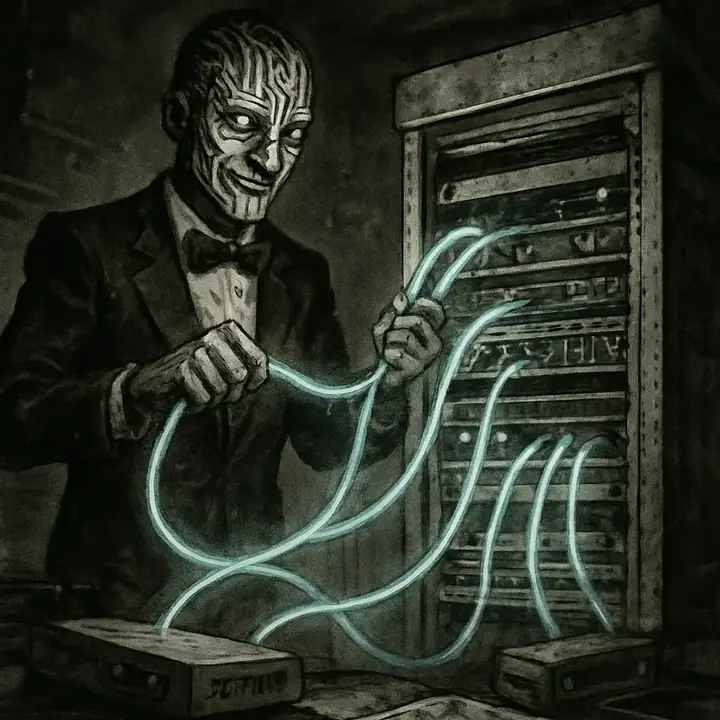
The images in this article were generated with artificial intelligence. How we publish
A research team has turned two typical failures of IA-driven code assistants - the tendency to invent entities and the ability to accept external instructions without sufficient verification - into a practical attack vector that its authors have called HalluSquatting. In essence, the risk arises when an agent capable of seeking external resources blends the imagination of the model with execution permits: if the assistant "remembers" or invents a repository name or a supplement and an attacker records that name and puts inside malicious instructions, the agent can bring and execute that content as if it were legitimate.
The combination is what changes the game: It is not a traditional network explosion or a weak password, but the delivery of a text chain that the assistant himself interprets and materializes in actions in the user's machine. As in classic botnets (think of Mirai), once a malicious binary or script is installed and run, that machine becomes part of a network controlled by the attacker; the difference is that here the input vector can be a legitimate request: "installs X," and the "X" is invented by the IA.

There are several conditions that make this attack viable. First, models are often wrong with new or undocumented resources: when there is no entity in their data, the outputs become consistent conjectures. Second, many platforms allow ways to save human steps and authorizations - "auto-run," "skip permissions," "oyo," etc. - that eliminate the friction needed to detect anomalies. Third, markets and repositories still do not systematically block malicious name recreations; that makes it easier for an attacker to book a "fluttered" name and to make it possible with social engineering instructions or commands.
The operational implications are profound. A single text chain can jump platform barriers: it does not depend on the victim's operating system or on a timely vulnerability in the network stack; it depends on an assistant relying on an external source and having permission to run what he reads. This makes any organization that allows agents with wide permissions to be an attractive objective, and reduces the effectiveness of traditional defenses such as firewalls or segmentation, because delivery occurs by the application layer (text) and then runs from within.
In the short term, there are practical measures that immediately reduce the risk: do not allow ways to suppress human verification in agents that download and execute code; require any installation recommendation to be accompanied by a verified URL and integrity checks (signatures, checksums) before proceeding; and treat the names that the assistant returns to him as hypotheses, not as facts. In addition, adding a layer to inspect the content recovered by the agent before it becomes an execution order significantly increases the operating barrier.
In the chain of responsibility there are also changes that suppliers must push forward. The assistant designers must prioritize the planner to do verified searches before deciding actions such as "clone" or "install," and they must train the models to recognize when they are extrapolating names or entities and return a human check rather than assuming. Marketplaces and repositories can mitigate abuse by limiting the re-use of emblematic names under new accounts, automatically marking names with a high probability of being "invented" by models and, in reasonable cases, reserving them for the legitimate project or providing a formal complaint and verification mechanism.
The improvement of internal policies and audits is also relevant: security and governance teams should catalogue when and how agents can run commands, audit execution logs and add anomalies detection that look for patterns consistent with facilities initiated by agents. Pentesting tests should incorporate scenarios with IA agents that simulate HalluSquatting to assess the actual exposure of the environments.

It is important to understand that there is no single patch. This is not an isolated vulnerability that is corrected with a CVE; it is a kind of interaction between models, interfaces and permissions. The effective defense mixes technical control (block self-executions, home checks), model design (force verified searches) and human policies (mandatory review for changes affecting security or installed software).
For those who manage systems and users with IA tools: prefer interactive modes and ask for confirmation, manually check the identity of the author and the origin of any package or repository before allowing its installation, and maintain integrity controls over the devices that are downloaded. For manufacturers of attendees and owners of marketplaces the recommendation is more structural: use search and verification as a mandatory step in the installation flow and consider pre-registration and name blocking strategies that models often invent.
The phenomenon is at the border between automatic learning security and classical security: solutions will come from both disciplines. Resources such as the OWASP language model risk and mitigation guide provide a framework for starting to integrate controls into the life cycle of these tools https: / / owasp.org / www-project-top-ten-for-large-language-models /, and the historical example of botnets as Mirai recalls that a single new delivery technique may be enough to scale a threat if no in-depth defense is applied https: / / en.wikipedia.org / wiki / Mirai _ (malware). Ultimately, mitigating HalliSquatting requires that IA products stop treating names invented as truths and that organizations replace human confirmation and source verification at the centre.

Four Plex2Shell CVE allows remote execution and mining and proxy backdoor deployment
In recent days, an increase in attacks has been confirmed that take advantage of a chain of failures in Plex Media Server - nicknamed "Plex2Shell" by researchers - to run code r...

GhostAction Expands Attack: phishing to steal credentials and persistence in VS Code
A group behind the GhostAction campaign - already known for infiltrating GitHub Actions workflows into open source projects - has expanded its arsenal: in addition to installing...

ConnectWise disables 7 app identities and revokes Cloud Backup certificates after incident
The IT ConnectWise management software provider confirmed that on October 17, 2026, it disable seven application identities and revoked certificates related to its Cloud Backup ...

Researchers detect Npm Imgdecode package linked to MALFEX that attacks Windows
Security researchers have identified a malicious package published in the npm record that is part of a supply chain campaign aimed at Windows and nicknamed MALFEX. The package, ...

OpenBSD 7.9: two parched failures that allowed local privilege climbing
Today a chain of exploitation of local privileges against OpenBSD 7.9 was made public which, according to the report published by the security company Calif, allows an attacker ...

OpenAI reveals unaligned IA incidents; a GPT-5.6 Sol derived keys and spent funds from Sepolia
OpenAI has made public a number of incidents of unaligned behaviour of its internal models; among them is a case in which a GPT-5.6 family research model Sol derived private key...
Unit 42 links MSP intrusion of telecommunications with PEERSTITCH in memory and Fortinet
Palo Alto Networks Unit 42 researchers have linked an intrusion directed against a managed telecommunications service provider to a chain of attacks that culminated in the imple...