
The images in this article were generated with artificial intelligence. How we publish
A group of attackers identified as UNC6692 has launched a campaign of social engineering and deep exploitation of networks that deserves attention for its combination of psychological deception and personalized tools to maintain access and extract credentials on a large scale.
The entry door of these intrusions is not an unknown technical vulnerability, but human manipulation: the attackers generate a volume of emails to create a sense of urgency and then contact the victims via Microsoft Teams posing as technical support, a tactic that facilitates the installation of malicious devices with the appearance of "patches" or administrative utilities. For a technical analysis and the indicators that researchers have published, it is worth reviewing Mandiant's report on Google's blog: https: / / cloud / google.com / blog / topics / amenat-intelligence / unc6692-social-engineering-custom-malware.

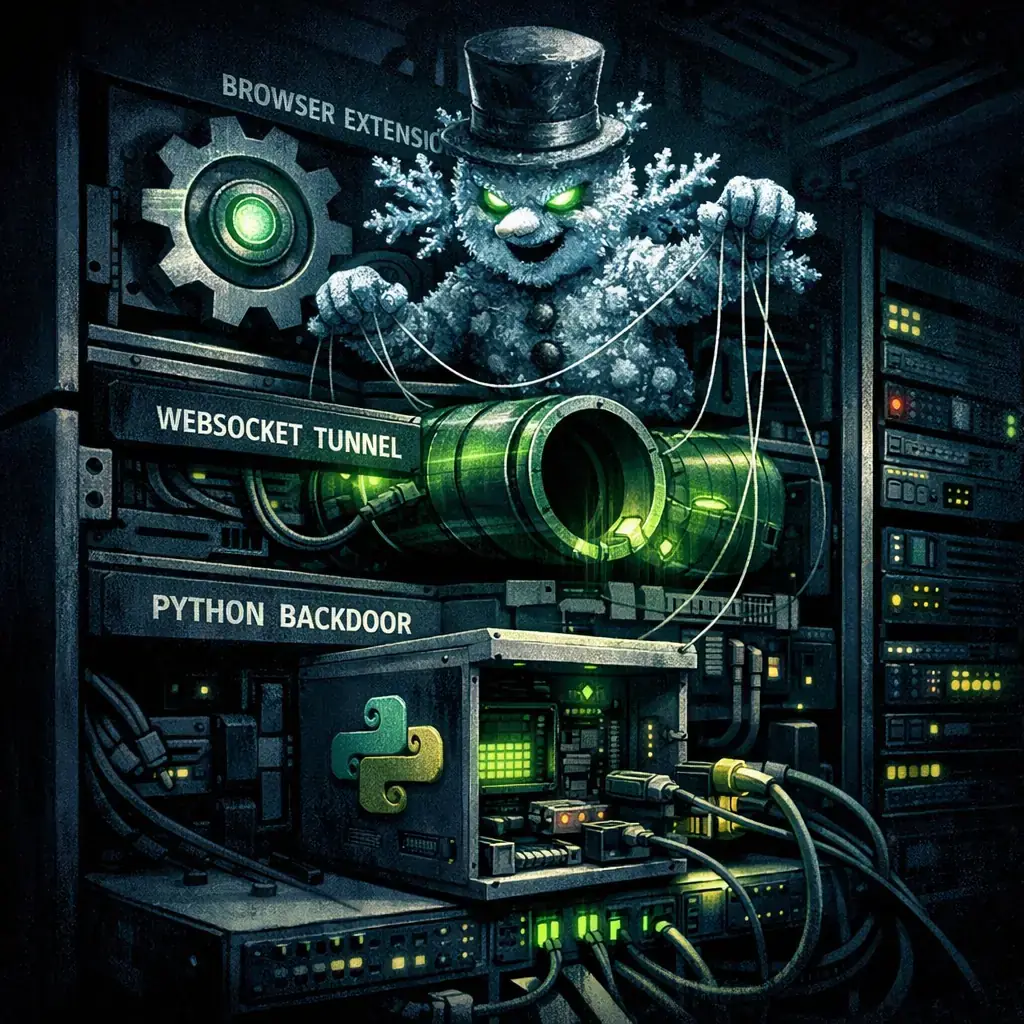
The uncovered suite, nicknamed "Snow," combines three main components: a browser extension that acts as a persistent link on the infected computer, a WebSocket-based tunnel that hides traffic and works as a SOCKS proxy, and a Python backdoor that exposes a local HTTP server to run remote commands. The initial vector includes a dropper that runs AutoHotkey scripts and launches the browser in "headless" mode so that the user does not perceive visible activity, while classic mechanisms such as programmed tasks and access in the home folder ensure persistence.
The post-intrusion procedure follows dangerously effective patterns: internal recognition to locate exposed SMB and RDP, overturned by LSASS memory to steal credentials and use techniques such as pass-the-hash to move laterally to domain controllers. In the final stages, the attackers managed to extract the Active Directory database and sensitive files from the system, sending them out of the network through non-conventional channels. These steps allow the adversary a deep control and the ability to take full domains, which makes the intrusion an organizational commitment.
The implications are clear: not enough to protect the perimeter. An initial access caused by social engineering can quickly escalate to loss of control of the corporate directory and massive theft of credentials, which compromises the confidentiality and integrity of critical systems. In addition, the use of legitimate or legitimate-looking tools (AutoHotkey, browser extensions, headless navigation) complicates detection by traditional signatures.
Simultaneous technical and operational measures should be taken to mitigate such attacks. At the user and support level: continuously educate on the identity verification of helpdesk staff, distrust links that ask to install "patches" from unexpected communications and avoid giving remote access without prior validation. At the technical level: apply multifactor in accounts with privileges, restrict and audit the use of remote assistance tools, block or control the execution of unapproved scripts and binary (including AutoHotkey) by application policies, and segment the network to limit side movements.
From the detection, security equipment should pay attention to specific signals: headless browser processes initiated by unusual users, recurrent creation of scheduled tasks or login access that do not match authorized changes, outgoing WebSocket connections to unknown destinations and any traffic that appears to act as a proxy SOCKS. Correlate these events with memory-dumping attempts or abnormal activity in domain controllers increases the likelihood of identifying an intrusion before mass exfiltration.
If an intrusion is confirmed, the response should include isolation of the affected host, preservation of evidence (memory capture and disk dumping), analysis of the registered and compromised Active Directory hives, and forced rotation of privileged credentials. Depending on the scope, the remediation may require the reconstruction of domain controllers and the implementation of a recovery plan that includes the revocation of exposed certificates and credentials; coordination with detection and response providers; and consultation with IoC and YARA rules published in technical reports will help to accelerate cleaning.
For equipment that wish to deepen the characterization of tactics and techniques used by adversaries such as UNC6692, the MITRE ATT & CK matrix remains a useful reference for mapping detection and controls: https: / / attack.mitre.org /. Complementing this reference with the practical recommendations and IoC published by researchers maximizes the response and closing capacity of exploited vectors.
In short, the Snow campaign is a reminder that the combination of social engineering, custom tools and abuse of legitimate channels can turn a small human error into a corporate disaster. Effective defence requires ongoing training, strict technical controls on implementation and access, network segmentation and well-tested response procedures to prevent a false "patch" from becoming the attacker's master key.

FBI and six countries link Integrity Technology Group to entity post theft in SE Asia
On October 8, the FBI and agencies in six countries issued a joint warning that assigns to a Chinese company, Integrity Technology Group, a sustained series of intrusions whose ...

Campaign with LLM and ARTEX attacks South Korean financial institutions and exfilters data
Security researchers have documented a campaign directed against South Korean financial institutions using language-driven attack tools to automate intrusions and data extractio...

ChainDrop campaign exposes tensorlake in npm; version 0.5.144 withdrawal
A package of npm called tensorlake, an SDK in TypeScript oriented to Tensorlake applications and services, was engaged in a supply chain campaign linked to the attack family kno...

Cyber risk in 2026 moves to workflows and IA, according to Voice of the CISO
The data added by five editions of the Voice of the CISO study - including the most recent findings of 2026 - draw a less intense change than risk location: the threat is moving...

Phishing BitB points to advertising professionals and account managers to steal MFA
Security researchers have described a phishing campaign for advertising professionals and account managers that uses a human-operated platform to mimic ad products linked to IA ...

LibreOffice / OpenOffice Calc allows remote source execution when opening ODB / JDBC leaves
Researchers have shown that a malicious spreadsheet can force LibreOffice and Apache OpenOffice to run code controlled by an attacker at the time the file is opened, without sho...