
The images in this article were generated with artificial intelligence. How we publish
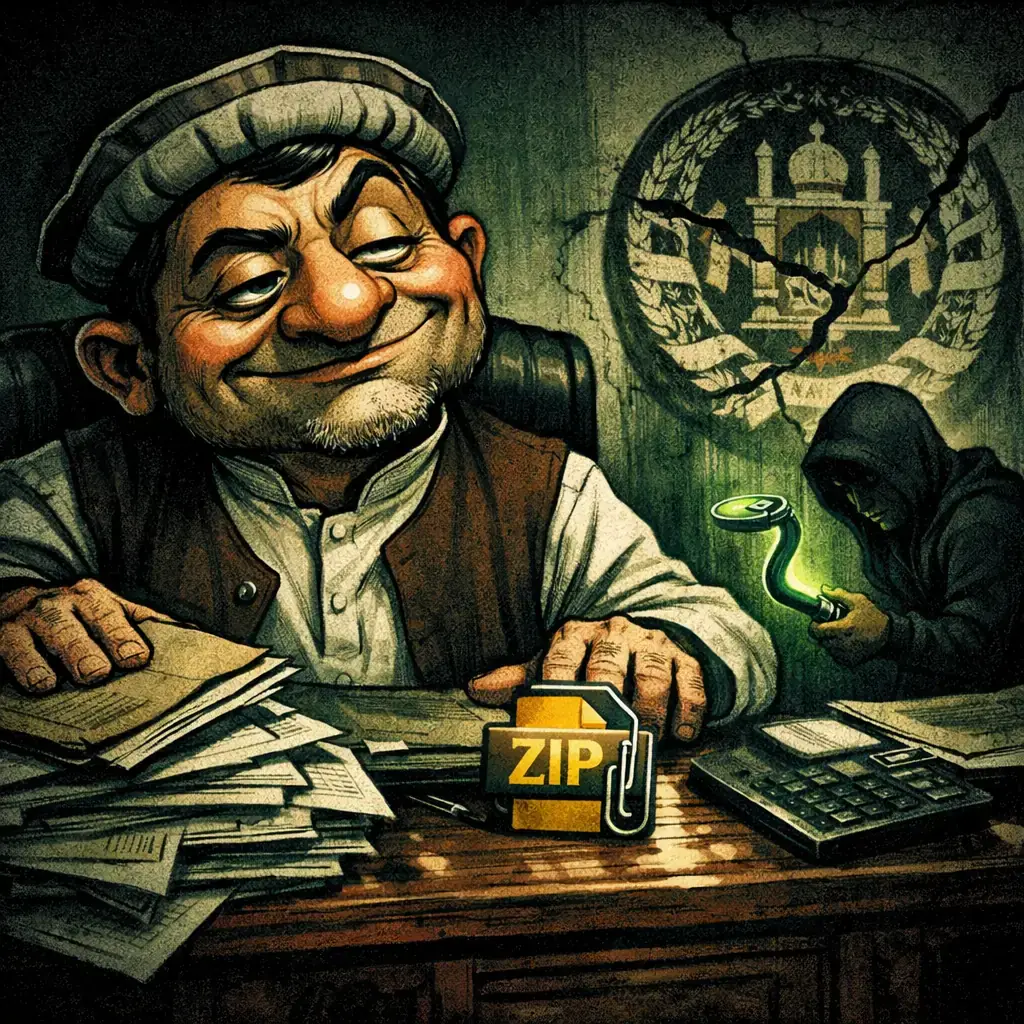
Security researchers have shown a campaign for the Afghan State financial machinery that combines social engineering techniques located with remote access tools that are easily available. Under the operational name Operation XENOFISCAL, the attackers - linked to the group known as SideCopy, associated with the wider Transparent Tribe- they used a ZIP file with a direct access (LNK) named in Pashto to commit officials and provincial hacienda addresses. The deliberate use of the pashto as a decoy is not anecdotal: it is proof that the opponent has knowledge of the objective environment and seeks to maximize the likelihood of the file being opened.
The infection chain takes advantage of Windows's native utilities to reduce the malicious signature: the LNK invokes mshta.exe to recover a HTA file hosted in a committed Afghan educational domain, leading to the execution in memory of JavaScript code. The scenario then includes persistence by Registry keys that simulate legitimate components (in this case, Microsoft Edge) and loading a loader in DLL that leaves on your computer version 1.8.7 of Xeno RAT next to a decoy document. To understand the mshta vector I recommend the official Microsoft documentation: https: / / learn.microsoft.com / en-us / windows-server / administration / windows-commands / mshta.

Xeno RAT is a tool capable of converting a committed host into a complete espionage and exfiltration platform: TCP communication with a control server, dynamic loading of DLL modules, programmed task creation, information collection on antivirus solutions, SokS5 tuning, file operations, key registration, screenshots, clipboard monitoring, access to webcam and microphone and the ability to remove your own persistence. Together, these functionalities allow both the silent extraction of financial data and the continued monitoring of administrative processes.
This incident is part of a broader campaign against the objectives of the subcontinent. On another front, operations aimed at Indian military infrastructure were described through manipulated .desktop Linux files, lures related to battleship vehicle contracts and a go-nicknamed implementation Deskrat. The recurrence of techniques and tools by the same group underlines a sustained strategy of intrusion and collection in the region. For context about the actor and his tactics, see the group profile at the MITRE ATT & CK base: https: / / attack.mitre.org / groups / G0066 /.
The implications are multiple. In the short term, the exfiltration of accounting and payroll data may facilitate fraud, economic sanctions or administrative manipulation. In the medium and long term, the persistence and monitoring capabilities open the door to covert operations that compromise the decision-making and fiscal security of entire provinces. From an operational point of view, the use of open source or widely available tools reduces the cost for the opponent and complicates detection when mixed with legitimate system processes.
For organizations and IT officials in government and financial environments, the immediate priority should be to contain and detect such intrusions. It is critical to restrict the implementation of mshta.exe and other interpreters from unreliable locations through application control policies (AppLocker or WDAC), tighten shortcut and HTA file execution rules and block automatic resource download from suspicious domains. The implementation of EDR solutions with the ability to monitor in memory and detect abnormal behavior substantially increases the likelihood of identifying an early infection.
Beyond technical hardening, human hygiene is crucial: training staff to identify lures in their native language, distrust of unexpected compressed files and verify through independent channels any communication involving documents or links related to financial procedures. In the event of suspicion, the affected machine should be isolated, the evidence (memory, records, process dumping) should be preserved for forensic analysis and the credentials and keys that may have been compromised should be rotated.
Finally, organizations should integrate specific detections into their log and telemetry: searches for unusual mshta executions, creating unprecedented programmed tasks, modifications to Run / RunOnce keys that mimic browsers, DLL loads from temporary locations and persistent TCP connections to non-scheduled destinations, especially if they show SOCKS5 tunnel patterns. Coordination between agencies, exchange of commitment indicators with regional partners and notification to competent authorities are necessary steps to mitigate the scope of campaigns which, such as Operation XENOFISCAL the operational and financial stability of public administrations.

OpenAI engineer arrested by hidden recorder in office board room in San Francisco
A United States court this week authorized the arrest of Abdulrahman Alfozan, an engineer who worked in OpenAI, following the U.S. government's charges for placing a hidden reco...

Four Plex2Shell CVE allows remote execution and mining and proxy backdoor deployment
In recent days, an increase in attacks has been confirmed that take advantage of a chain of failures in Plex Media Server - nicknamed "Plex2Shell" by researchers - to run code r...

GhostAction Expands Attack: phishing to steal credentials and persistence in VS Code
A group behind the GhostAction campaign - already known for infiltrating GitHub Actions workflows into open source projects - has expanded its arsenal: in addition to installing...

ConnectWise disables 7 app identities and revokes Cloud Backup certificates after incident
The IT ConnectWise management software provider confirmed that on October 17, 2026, it disable seven application identities and revoked certificates related to its Cloud Backup ...

Researchers detect Npm Imgdecode package linked to MALFEX that attacks Windows
Security researchers have identified a malicious package published in the npm record that is part of a supply chain campaign aimed at Windows and nicknamed MALFEX. The package, ...

OpenBSD 7.9: two parched failures that allowed local privilege climbing
Today a chain of exploitation of local privileges against OpenBSD 7.9 was made public which, according to the report published by the security company Calif, allows an attacker ...

OpenAI reveals unaligned IA incidents; a GPT-5.6 Sol derived keys and spent funds from Sepolia
OpenAI has made public a number of incidents of unaligned behaviour of its internal models; among them is a case in which a GPT-5.6 family research model Sol derived private key...