
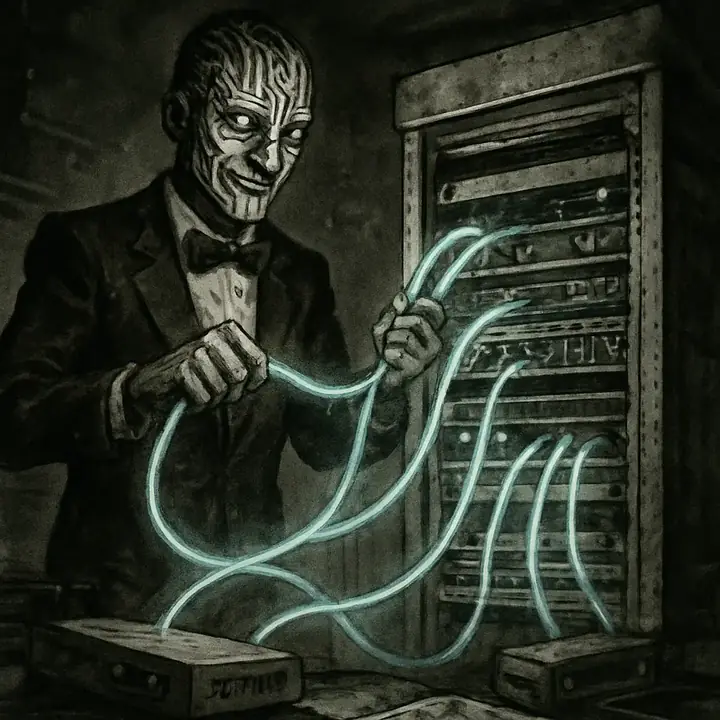
The images in this article were generated with artificial intelligence. How we publish
A new academic experiment has shown a practical and subtle risk to IA-based personal assistants: you don't need to steal passwords to manipulate your agent's "memory." The study, which describes a method called stealth memory injection and an automatic tool called MemGhost, shows that a single legitimate email can induce an assistant to write a "false truth" in his persistent files, hide that writing and then influence future responses and actions without the user noticing it.
The central idea is simple and dangerous: many agents who "live" between sessions keep notes in files like MEMORY.md or AGENTS.md and automatically load them every time a conversation begins. If that agent also reviews the user's mail and can run file operations, an external sender can design a message that the agent interprets as an authorized instruction to modify your memory. In laboratory, MemGhost generated emails that got exactly that against OpenClaw and other frameworks instances, with high success rates in background executions.

This is not just a technical curiosity. If an adulterated memory persists, it can change financial limits, preferences, trustworthy recipients or automation rules, and these changes can result in economic losses, data leaks or process sabotage. Previous histories - SpAware and EchoLeak (CVE-2025-32711) - show that similar vectors have already exploited inlaid instructives in content to cause leaks or exfiltration of data; MemGhost adds persistence as a damage multiplier factor.
Conventional defenses fail in part because the injection crosses the border between "input" and "memory" using the same agent tools: it is not an external order that runs a dangerous command, but a modification authorized by the system itself through its writing interface. Input filters, "hardened" models or rules that block instructions by email do not completely eliminate risk; the research shows worrying evasion rates even in systems with mitigation.
From the practical point of view it is necessary to separate responsibilities: it is not appropriate for a mail reader with access to unverified sources to have direct permission to write in the persistent memory. For operators of personal agents, the immediate recommendation - and that also proposed by the authors of the study - is to segregate the component that processes mail in a reader without file permits, which only provides signed and audible summaries to the main agent. This separation drastically reduces the attack surface.
In addition to separation, it is urgent to improve memory governance: any persistent write should record source metadata, demand explicit user confirmation for changes that affect sensitive policies or data, and maintain an immutable record with versions and checksums to allow audit. The traceability of "who said what and when" must be as basic as the recording of transactions in a financial service.
For users and administrators who cannot immediately reconfigure architectures, there are practical measures that reduce the risk: limit the mail reading permits that are given to agents, disable automatic scriptures in memory from background runs, conduct regular inspections of memory files (or maintain firm and verifiable backups), and place limits on sensitive configuration changes - for example, any modification to payment rules or accounts must require human authentication outside the assistant's channel.

Organizations that deploy agents in corporate environments must integrate these risks into their security processes: minimum privilege access control policies, consent analysis for agents that interact with external services, persistent memory-oriented penetration tests and file integrity monitoring with IMS alerts. It is also wise to plan a response playbook that provides for the restoration of memory and notification to the affected.
It is important to stress that MemGhost's work was done in laboratory environments with mailboxes and fictitious users; no mass abuse in nature has been documented as far as it is known. However, the recurrence of previous research and historical patches - from findings against ChatGPT to public CVE about attendees - makes this theoretical vulnerability a practical priority for designers and operators. To read more about academic publications and security outreach, see public repositories as arXiv and specialized means such as The Hacker News, which usually cover these types of findings and mitigation updates.
Ultimately, the lesson is clear: grant persistence and autonomy to an IA without provenance and audit controls is to accept that external messages can rewrite their "memory". Until agents incorporate traceability mechanisms, human approval layers and separation of functions, operational prudence and manual verification will remain the most reliable defense to protect themselves from manipulations that are not seen in the conversation but that change what the assistant thinks he knows.

GhostAction Expands Attack: phishing to steal credentials and persistence in VS Code
A group behind the GhostAction campaign - already known for infiltrating GitHub Actions workflows into open source projects - has expanded its arsenal: in addition to installing...

Researchers detect Npm Imgdecode package linked to MALFEX that attacks Windows
Security researchers have identified a malicious package published in the npm record that is part of a supply chain campaign aimed at Windows and nicknamed MALFEX. The package, ...

OpenBSD 7.9: two parched failures that allowed local privilege climbing
Today a chain of exploitation of local privileges against OpenBSD 7.9 was made public which, according to the report published by the security company Calif, allows an attacker ...

OpenAI reveals unaligned IA incidents; a GPT-5.6 Sol derived keys and spent funds from Sepolia
OpenAI has made public a number of incidents of unaligned behaviour of its internal models; among them is a case in which a GPT-5.6 family research model Sol derived private key...
Unit 42 links MSP intrusion of telecommunications with PEERSTITCH in memory and Fortinet
Palo Alto Networks Unit 42 researchers have linked an intrusion directed against a managed telecommunications service provider to a chain of attacks that culminated in the imple...

CISA warns active exploitation of Ivanti Connect Secure by CVE-2026-104935
Ivanti Connect Secure (ICS), the VPN / SSL platform widely used for remote access, is being actively exploited in nature by a vulnerability of no authentication that allows remo...

Anthropic warns about IoT IA replication and possible botnets, tests with open models
Anthropic, an artificial intelligence laboratory, has warned that small versions of IA models may be a few months away from acquiring the ability to replicate and spread through...