
The images in this article were generated with artificial intelligence. How we publish
The industry's reports are clear: the attackers accelerate and our metrics do not improve at the same speed. Recent reports like Google's M-Trends analysis of threat trends show action windows of attackers that have been drastically reduced, while studies such as IBM's on the cost of gaps keep identification and containment times that remain too long for the pace of attacks ( M-Trends 2026, IBM - Cost of a Data Break). This gap between the speed of the attacker and the operational response capacity is why, despite a rising security expenditure, the risk equation does not change proportionally.
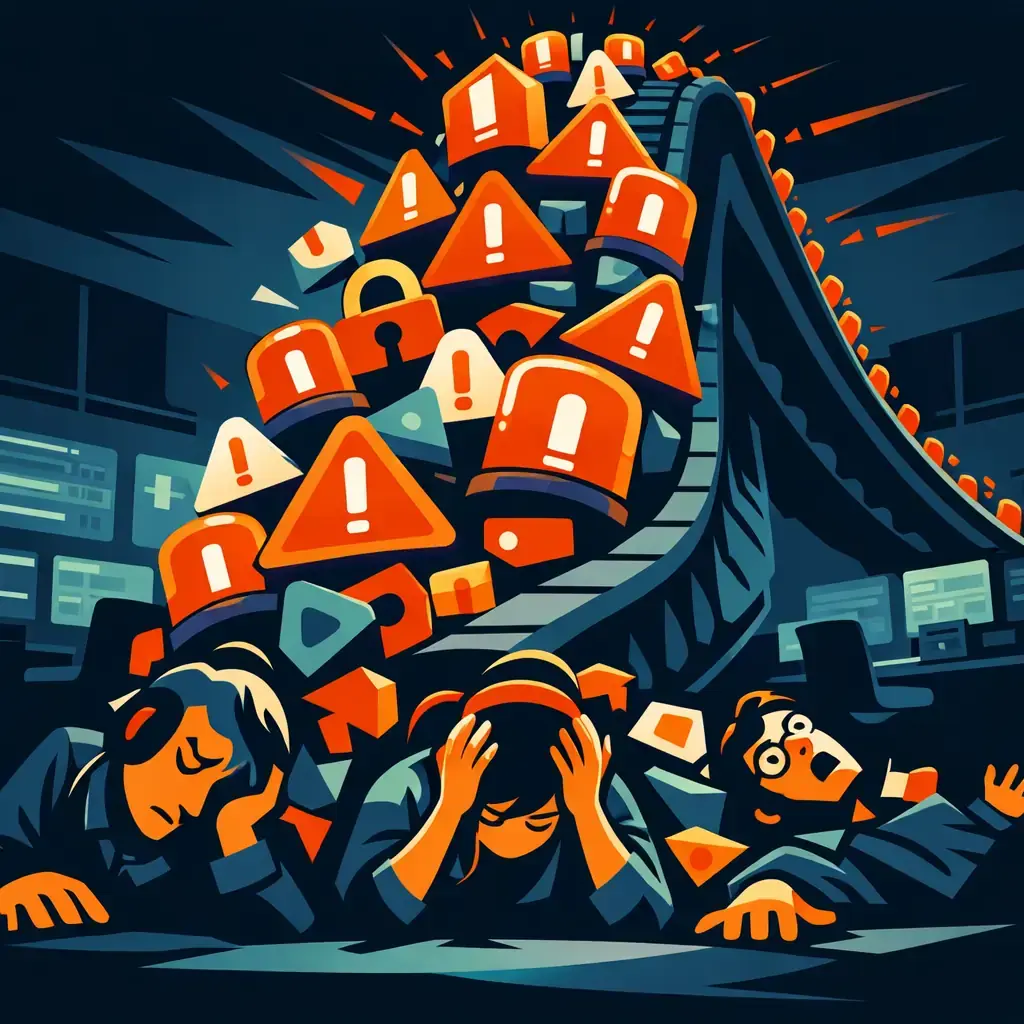
It is not so much a problem of people as of operational architecture: expanding the staff can improve coverage marginally, but it does not transform a model designed for people to investigate massive volumes of alerts into a sustainable model. Many SOC already apply the obvious tactics - warning stratification, noise suppression, point automations - and yet the work tail that demands deep human judgment remains too large.

If your SOC accumulates alerts, the real attack may be in that forgotten tail. Instead of accepting the narrative of "we need more analysts," it is appropriate to make a quick and honest diagnosis in less than five minutes. Ask yourself, without answering in aspirational terms: what real percentage of alerts above the threshold was investigated last quarter; how many detection rules have been removed without engineering having taken over; what rotation was among senior analysts and how long it took to be fully productive again; and if the volume of alerts were to be doubled tomorrow, what activity would be cut first? If three or more responses reveal weakness, the focus should change from hiring to redesign the workflow.
What makes it possible to automate the investigation? When tools with automated research capabilities assume the repetitive tasks - collecting evidence, running pivots against sources, documenting chains of reasoning - two effects emerge: the tail is reduced and released seniors analysts can spend time on detection engineering and hunting for new threats that require human intuition. This does not mean fully replacing people: certain investigations, such as internal threats with contextual signals outside the records, unprecedented tactics in training data or environments with regulatory data residence restrictions, continue to require human leadership.
If you evaluate platforms that promise to investigate on a scale, ask specific questions that many light sales avoid. It requires transparency on what happens when the tool is wrong: who can see and correct the chain of reasoning; how are corrections documented to avoid recurrence? Ask for details on the impact on the detection engineering function: how does feedback become rules improvements and noise reduction? And don't forget critical contractual guarantees: data portability, independence of playbooks and contractual continuity in the face of supplier acquisitions or closures.
The real economic argument usually comes from three combined vectors: replace a forthcoming approved procurement, cut costs of intake and storage in the IMS when the pivoting becomes directly against origins, and in the medium term move redundant tools. In practice, most programmes finance adoption with a mix of these three mechanisms; savings in ICES infrastructure are often a multiplier that financial equipment takes time to model if not clearly explained.
For adoption to be sustainable, implementation requires two to four weeks of tuning and a clear plan to reallocate the time released from analysts. If improved detection is not institutionalized as a planned discipline with owners, the quality of the alerts will tend to degrade. In parallel, it includes from the beginning IT, compliance and legal in the evaluations: questions about data flow, integrations and contractual agreements usually slow down processes if they are discovered late.
Not all levers have the same political complexity: Using uncovered recruitment space to pay for the tool is the easiest way; capturing savings from IMS needs synchrony with renewal cycles; moving consolidated tools requires change management and is usually a second year agenda. Antiquise internal brakes and design governance milestones to measure real return, not just the promise of efficiency.
Finally, the consideration of risk provider deserves care: it confirms the ability to export research histories and configurations, that human runbooks are legible outside the platform and that there are contractual clauses that require continuity of service or orderly migration in case of corporate events. The absence of clear responses on these three points is a risk signal that must be weighted along with the projected savings.
The conclusion for security officials is practical: Stop thinking that more headcount will solve the gap; make a quick diagnosis of operational coverage, reevaluate the research architecture and prioritize solutions that reduce the tail and improve feedback to detection engineering. If you decide to test an automated platform, design the concept test to measure not only the false positive rate, but also the actual operating savings, the quality of the audit trail and the ability to keep the knowledge out of the supplier. If you need reference frameworks and standards to assess IA risks in your project, see reference resources such as those of the NIST on IA ( NIST AI) to complement the technical and legal review.

OpenAI engineer arrested by hidden recorder in office board room in San Francisco
A United States court this week authorized the arrest of Abdulrahman Alfozan, an engineer who worked in OpenAI, following the U.S. government's charges for placing a hidden reco...

Four Plex2Shell CVE allows remote execution and mining and proxy backdoor deployment
In recent days, an increase in attacks has been confirmed that take advantage of a chain of failures in Plex Media Server - nicknamed "Plex2Shell" by researchers - to run code r...

GhostAction Expands Attack: phishing to steal credentials and persistence in VS Code
A group behind the GhostAction campaign - already known for infiltrating GitHub Actions workflows into open source projects - has expanded its arsenal: in addition to installing...

ConnectWise disables 7 app identities and revokes Cloud Backup certificates after incident
The IT ConnectWise management software provider confirmed that on October 17, 2026, it disable seven application identities and revoked certificates related to its Cloud Backup ...

Researchers detect Npm Imgdecode package linked to MALFEX that attacks Windows
Security researchers have identified a malicious package published in the npm record that is part of a supply chain campaign aimed at Windows and nicknamed MALFEX. The package, ...

OpenBSD 7.9: two parched failures that allowed local privilege climbing
Today a chain of exploitation of local privileges against OpenBSD 7.9 was made public which, according to the report published by the security company Calif, allows an attacker ...

OpenAI reveals unaligned IA incidents; a GPT-5.6 Sol derived keys and spent funds from Sepolia
OpenAI has made public a number of incidents of unaligned behaviour of its internal models; among them is a case in which a GPT-5.6 family research model Sol derived private key...