
The images in this article were generated with artificial intelligence. How we publish
As organizations adopt and deploy their own large-scale language models, they not only bring up a model to production: they create a whole network of internal services and APIs that feed, manage and connect it to the rest of the company. The current risk in many deployments of LLM does not come from both the model itself and the surrounding infrastructure., and every new endpoint - that door through which requests come and go - increases the attack surface in ways that are often overlooked in the hurry to experience and iterate.
In this context it is appropriate to clarify what we understand by endpoint: it is any point of interaction where a user, an application or a service can communicate with the model. It can be inference APIs that process prompts and return responses, control panels to manage versions, management interfaces to update plugin models or execution points and tools that allow LLM to consult databases or invoke other services. In practice, these endpoints determine how the LLM is integrated with its environment and, thus, what will be the surface available to an attacker.

A common pattern is that these endpoints are designed by thinking of speed and ease of use, not hardening. Prototypes, tests and internal APIs that are born to accelerate experiments are often operational without continuous monitoring measures. When an endpoint accumulates credentials with extensive permits or unrotated long-term tokens, unnoticed access can result in much greater privileges than those envisaged by its creators, because endpoint itself acts as a security limit: its identity, the handling of secrets and the scope of its permits define how much an attacker can advance.
The exposure is almost never produced by a single spectacular failure; it is slowly forged by repeated assumptions and shortcuts: internal APIs open to the outside to facilitate rapid integration, embedded tokens in configurations that never renews, the false confidence that "if it is internal there is no need for protection," endpoints of proof that are never removed and rules of firewall or poorly configured gateways in the cloud that make a service that should be private accessible. These little carelessness transform a useful API into an exploitable vector.
The danger is especially acute in LLM environments because these models often work as orchestrators: they connect data sources, internal tools and cloud services to automate workflows. Therefore, compromising a single endpoint is not limited to "stealing" output from the model; it can allow lateral movement to systems that already rely on that LLM. The real threat is not so much that the model is too "powerful," but that the endpoint that exposes it enjoys implicit trust and extensive permissions., becoming a multiplier of automated malicious actions.
Among the techniques that can be used if an endpoint is in the wrong hands are the prompt-based injuries that induce the model to extract and summarize sensitive information to which it has access, the abuse of tool permissions connected to modify resources or execute commands, and indirect injections where data manipulated in an input source lead the model to perform unwanted actions. These tactics take advantage of both the LLM's own automation and the fact that many flows run without permanent human supervision.
One factor that amplifies these problems is so-called non-human identities: service accounts, API keys and other credentials that use systems rather than people. For convenience, these identities are often given too wide permits and are not reviewed over time. The result is a dangerous cocktail composed of secrets scattered in pipelines and repositories, static credentials that are not rotated, permits accumulated beyond what is necessary and a proliferation of identities that reduces visibility over who can do what.
Reducing this risk requires changing the approach: to assume that at some point an endpoint will be reached by an attacker and to design to make the extent of the damage minimal. Applying zero trust principles to each interface is a good guide: to require explicit verification, to continuously review the authorizations and to permanently monitor the activity. In practice, this means imposing the principle of less privilege on both humans and machines, limiting the life time of access by means of just-in- time access mechanisms, auditing and recording privileged sessions to detect abnormal behaviors, and automating the rotation of secrets so that the credentials exposed will no longer be useful after a few hours or days.
Infrastructure and cloud manufacturers already recommend patterns that support these ideas: using cloud-managed identities to avoid static keys, following good IAM practices that decrease default permissions, and using secret management solutions that allow short-term credentials to be issued and audited. Tools such as secret managers (e.g., HashiCorp Vault) and the managed identity mechanisms of cloud suppliers ( Azure Managed Identity) or AWS's AMI recommendations ( AWS IAM best practices) help reduce exposure by static credentials and mitigate the "spiral" of permits.
It is not just about adopting technologies, but about rethinking procedures: automating the expiry of privileges, implementing telemetry so that each call to an endpoint is subject to detection and response, and auditing endpoints created for experiments so that they do not become forgotten doors. The zero trust architecture guidelines and reference frameworks provide a solid conceptual framework for this conversion; for example, the NIST document on Zero Trust Architecture is a recommended reading for security equipment that want to adapt their controls to the context of distributed and automated systems ( NIST SP 800-207).
The specific recommendations for API and application traffic should also be taken into account: OWASP API Security summary threats and controls for interfaces that, in the LLM world, are precisely the critical points of exposure. In addition, protection from prompt injections and abuse of connected tools requires thinking of security not only at the network level and credentials, but also at the level of design of interaction between model and context.
Ultimately, the management of privileges by endpoint should become an organizational priority: reorient efforts from a reactive stance that seeks to prevent access to a strategy that limits what an attacker can achieve if he reaches an endpoint. This philosophy is the one that underlies solutions that help to remove unnecessary permissions and protect non-human identities on a continuous basis; specialized suppliers, such as those that offer endpoint privilege management they propose operational components that facilitate the application of these principles in IA infrastructure.
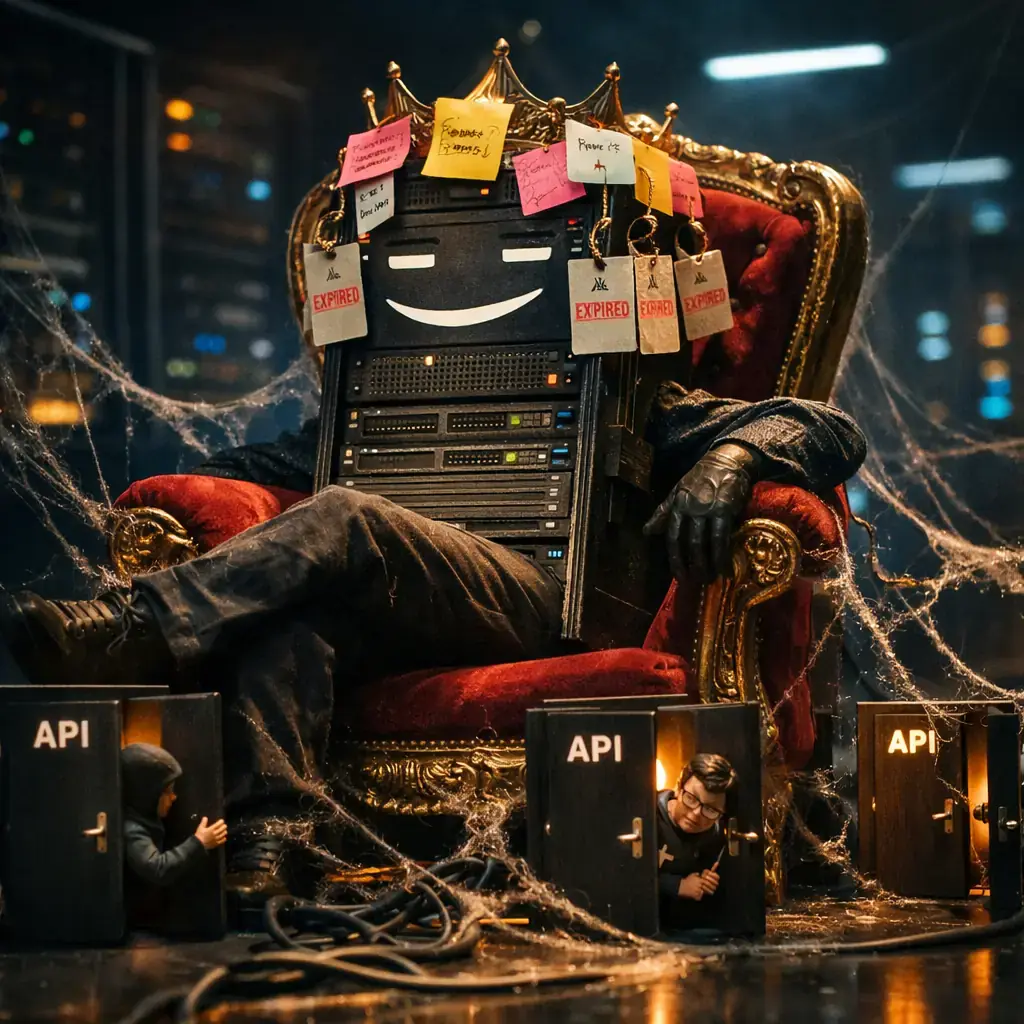
Protecting LLMs is not just protecting models; it is shielding the small doors that connect them with everything else. By rigorously managing who and when can do something at each endpoint, by replacing permanent credentials with temporary and audited access, and by applying a minimum confidence model, organizations effectively reduce the possibility of a single open door becoming a massive gap.

Four Plex2Shell CVE allows remote execution and mining and proxy backdoor deployment
In recent days, an increase in attacks has been confirmed that take advantage of a chain of failures in Plex Media Server - nicknamed "Plex2Shell" by researchers - to run code r...

GhostAction Expands Attack: phishing to steal credentials and persistence in VS Code
A group behind the GhostAction campaign - already known for infiltrating GitHub Actions workflows into open source projects - has expanded its arsenal: in addition to installing...

OpenCode: possible exposure of AI suppliers in Console affects 1.4% of users
On the night of October 16 there was an unauthorized access to a system inherited from OpenCode which, according to the company, could have exposed keys from IA suppliers that u...

ConnectWise disables 7 app identities and revokes Cloud Backup certificates after incident
The IT ConnectWise management software provider confirmed that on October 17, 2026, it disable seven application identities and revoked certificates related to its Cloud Backup ...

Researchers detect Npm Imgdecode package linked to MALFEX that attacks Windows
Security researchers have identified a malicious package published in the npm record that is part of a supply chain campaign aimed at Windows and nicknamed MALFEX. The package, ...

OpenBSD 7.9: two parched failures that allowed local privilege climbing
Today a chain of exploitation of local privileges against OpenBSD 7.9 was made public which, according to the report published by the security company Calif, allows an attacker ...

OpenAI reveals unaligned IA incidents; a GPT-5.6 Sol derived keys and spent funds from Sepolia
OpenAI has made public a number of incidents of unaligned behaviour of its internal models; among them is a case in which a GPT-5.6 family research model Sol derived private key...