
The images in this article were generated with artificial intelligence. How we publish
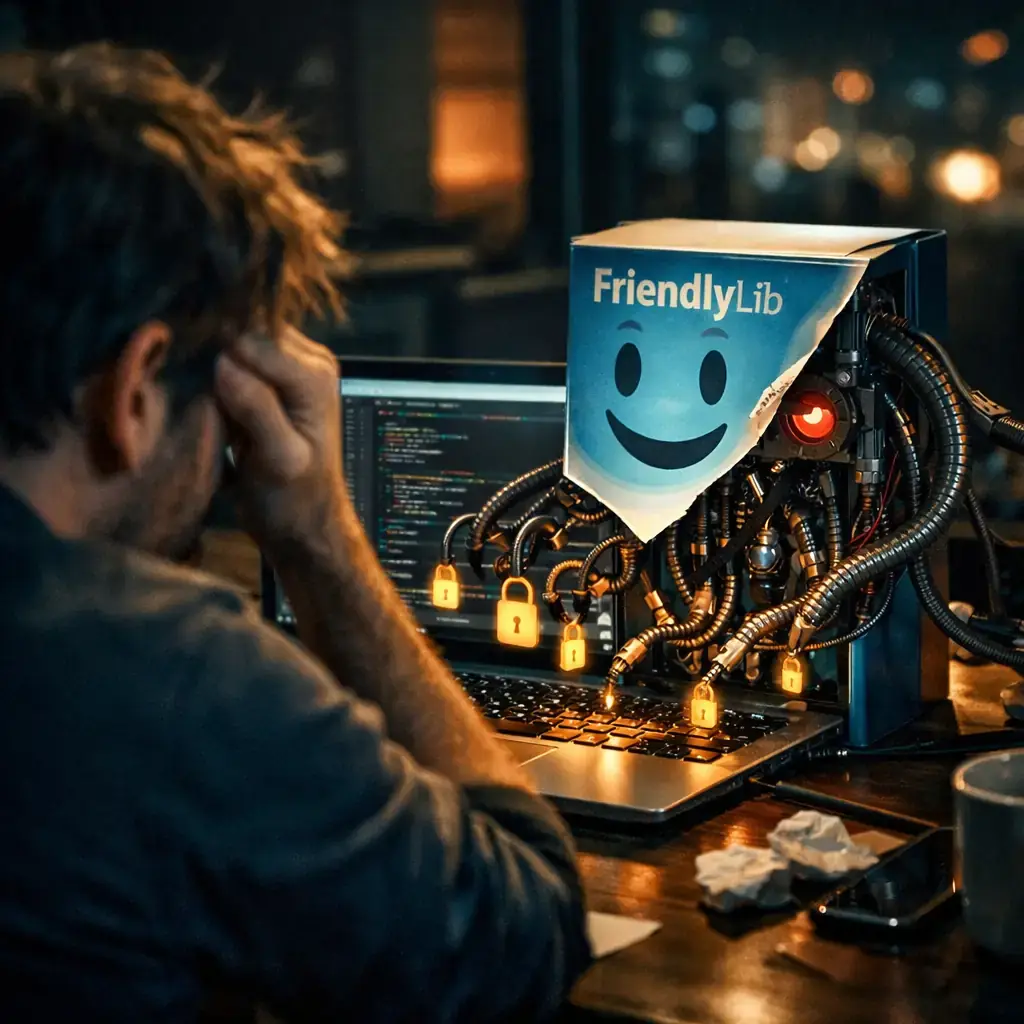
Security researchers have identified a new wave of malicious packages in the npm ecosystem that imitate legitimate polyfilling tools for Rollup with the explicit intention of obtaining remote access and stealing credentials and sensitive data from development workstations and construction machines. According to public analysis, malicious artifacts were presented with names and metadata almost identical to known projects, contained a first step that concealed commands encoded in Base64 and downloaded a second step dressed as SVG utilities that in turn recovered and executed JavaScript code from an external JSON repository; that step structure and environment checks to avoid sandboxes recall previous campaigns attributed to North Korean actors.
The central technical lesson is that attackers no longer limit themselves to stranded versions of malware: they build supply chains with apparently harmless components in the register that hide installation hooks, evasion controls and payloads that allow so much exfiltration of secrets (tokens npm, SSH keys, .env credentials, browser data and wallets) how Remote host control (interactive execution, screen capture, mouse automation and keyboard). These capabilities are especially dangerous when the package is incorporated into local Rollup configurations, CI environments or construction images that already have access to critical development secrets and artifacts.

From the operational point of view, this amplifies a recurring risk: the code we install in development time has the same possibility of becoming an attack vector as any production software. It is therefore a matter of concern that attacks combine plausible names and metadata, several-stage payload and hidden execution during installation to mute surface inspections and automated records controls.
If your team has recently used packages with names including "rollup," "polyfill," "runtime" or new packages published by unverified accounts, treat the situation as a possible intrusion. The initial measures should include the immediate removal of identified units, the search for any execution of post-installation or unloaded devices on development and build machines, the rotation of exposed credentials (tokens npm, SSH keys, cloud credentials) and the revocation of access until the integrity of the environment is used.
In preventive and hardening terms, it is necessary to adopt several additional defenses: to set up unit facilities with --ignore-scripts when feasible to block installation hooks, to use isolated and ephemeral building environments (containers or runners with minimal privilege), to activate CI / CD unit scanning using tools such as Dependabot or commercial SCA, and to validate that the artifacts come from reliable authors and scopes. It is also recommended to audit and set dependencies (lockfiles), review changes in transitional dependencies before accepting merges and limit the use of long-term tokens in CI.
For research and detection, look for indicators such as calls to JSONKeeper or other snippet storage services, output connections to PIs or suspicious domains from development environments, processes that invoke @ nut-tree-fork / nut-js in Windows hosts and unusual activity by reading editor configuration files or IA tools. If you detect engagement, capture logs and samples before reboot, and consider rebuilding images of affected systems from clean sources if there is evidence of persistence.
Public tools and resources help automate part of the work: teams should integrate unit scanners and lock lists into the pipeline, and use audit projects such as OWASP for software dependence and composition. More information on risks and good practices is available in industry publications and guides, for example in the JFrog research blog and in resources on unit management and repository security. You can start reviewing practical guidance in https: / / jfrog.com / blog / and study composition analysis tools in https: / / owasp.org / www-project-dependency-check /.
Finally, do not lose sight of the fact that these types of campaigns are part of a broader trend of supply chain poisoning: effective prevention requires organizational policies (principle of less privilege, regular rotation of secrets, 2FA and tokenization) as well as technical controls. Activate the scanning of CI dependencies, treat new packages from unverified areas as critical and maintain response procedures that consider the real possibility of exfiltration and remote control of development and build environments.

Four Plex2Shell CVE allows remote execution and mining and proxy backdoor deployment
In recent days, an increase in attacks has been confirmed that take advantage of a chain of failures in Plex Media Server - nicknamed "Plex2Shell" by researchers - to run code r...

Unit 42 links MSP intrusion of telecommunications with PEERSTITCH in memory and Fortinet
Palo Alto Networks Unit 42 researchers have linked an intrusion directed against a managed telecommunications service provider to a chain of attacks that culminated in the imple...
Linux Kernel allows host memory reading from a VM; CVE-2026-99999 patch.
The security community has confirmed a critical vulnerability in the Linux kernel network code that allows code that is already running within a virtual machine (VM) to read mem...

Laboratory shows code execution in Windows SFAPE enclave (CVE-2026-83498) and patch
Researchers at the Doyensec firm have shown in laboratory that it is possible to run code chosen by an attacker within a portion of Windows memory that should remain sealed even...

Safety report of agents IA: 1,280 products, 282 with SSO; majority without identity control
A new report on the safety of IA agents presents a worrying but concrete picture: in the environments examined for the 2026 State of Agent Security Report There are about 1,280 ...

Campaign with LLM and ARTEX attacks South Korean financial institutions and exfilters data
Security researchers have documented a campaign directed against South Korean financial institutions using language-driven attack tools to automate intrusions and data extractio...
Cybersecurity report: defense is no longer a point, it is continuous visibility and scalable response
A new public report on cybersecurity describes how cloud expansion, artificial intelligence and distributed systems are changing the goal and protection priorities: it is no lon...