
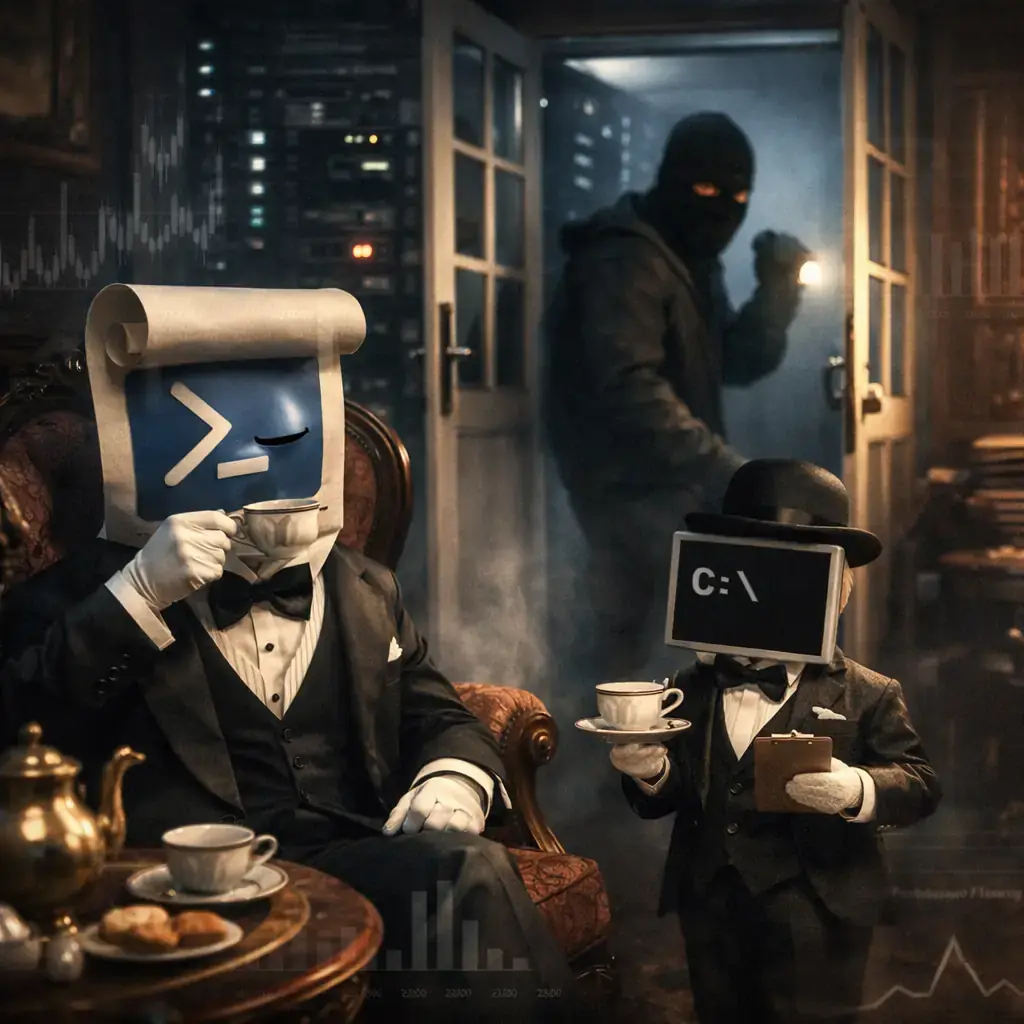
The images in this article were generated with artificial intelligence. How we publish
Modern intrusions no longer always look like classic malware with signature and noise: many are disguised as legitimate administrative tasks. Native Windows tools - from PowerShell to command line utilities or components used by third-party applications - offer a set of movements that attackers reuse to move, establish persistence and extract data without lifting the same alerts as a malicious binary. That camouflage capacity turns a detection problem into an exposure problem: not enough to look for malware, you have to reduce what an intruder can do with what already exists within the perimeter.
Data from specialized teams show that the abuse of legitimate profits is present in most high-gravity incidents, and that artifacts such as PowerShell are executed in a very high proportion of endpoints, often fired by management software or third-party integration. The operational conclusion is clear: it's not just an antivirus failure, it's an over-entitling - too many accounts, too many capabilities available for too many machines.

What does this mean for an organization? First, that the "detect and respond" strategy is no longer enough on its own: when an attacker can move in minutes using legitimate tools, the times of research and containment become critical. This is why proactive approaches emerge that map and reduce the usable surface before intrusion occurs. It is a difference between waiting for the alarm to sound and closing the doors that the intruder would need to enter sensitive areas.
An internal evaluation of the "attack surface" turns the hypothesis into facts: it reveals which legitimate users, stations and binaries are being used in a way that is dangerous. Measuring exposure and prioritizing specific controls allows defensive decisions against the directory and regulators, while reducing the load of the SOC by eliminating whole classes of noisy alerts. This type of evaluation usually combines telemetry with machine-user torque learning to differentiate legitimate use of potential abuse.
On the technical level, mitigation levers are known but require discipline to apply them without breaking the operation: apply the principle of minor privilege, introduce execution policies (AppLocker, Windows Defender Application Control), use just-in-time privileged management mechanisms, and segregate service accounts. To this should be added "living-off-the-land" tool control through context-focused policies - which user in which machine can invoke such utility - rather than blocking it globally.
Automate risk reduction with controls that allow capacity to be revoked and, if necessary, return them by means of an agile approval flow. A controlled and reversible reduction is more viable than massive blockages: it maintains continuity while disassembling the preferred vectors by the attackers. The telemetry that supports these decisions - what was used, by whom and how often - is the currency to justify changes before auditors and insurers.
Not all organizations need the same recipe: heavy Windows environments require priority attention, but the principle is universal. Before deploying invasive controls it is appropriate to go through an observation and learning phase to create an operational base line; without such reference, corrective measures may cause unnecessary interruptions. Measuring before, reducing with criterion and remeasuring later is the sequence that converts effort into tangible value.
For technical teams that want to deepen techniques that abuse legitimate profits and standardized defensive tactics, it is useful to review public reference frameworks such as MITRE ATT & CK ( https: / / attack.mitre.org /) and official documentation of critical tools such as PowerShell ( https: / / learn.microsoft.com / powershell /), which help translate telemetry into applicable controls. For organizations looking for integrated commercial solutions, endpoint and surface reduction platform providers publish specific guides and offers; for example, endpoint solution product pages can serve as a starting point for evaluating consolidated functionalities ( https: / / www.bitdefender.com / business / enterprise-products / gravityzone.html).
In short, changing the defensive position requires moving from responding to incidents to prevent significant movements within the environment. This change requires behaviour-based visibility, rights-reducing policies and the ability to implement precise measures without paralyzing business. For those responsible for security, the challenge is simple in formulation but hard in execution: to identify what of what is already inside must be cut and to do so in a measurable, repeatable and justifiable way.

FBI and six countries link Integrity Technology Group to entity post theft in SE Asia
On October 8, the FBI and agencies in six countries issued a joint warning that assigns to a Chinese company, Integrity Technology Group, a sustained series of intrusions whose ...

Campaign with LLM and ARTEX attacks South Korean financial institutions and exfilters data
Security researchers have documented a campaign directed against South Korean financial institutions using language-driven attack tools to automate intrusions and data extractio...

ChainDrop campaign exposes tensorlake in npm; version 0.5.144 withdrawal
A package of npm called tensorlake, an SDK in TypeScript oriented to Tensorlake applications and services, was engaged in a supply chain campaign linked to the attack family kno...

Cyber risk in 2026 moves to workflows and IA, according to Voice of the CISO
The data added by five editions of the Voice of the CISO study - including the most recent findings of 2026 - draw a less intense change than risk location: the threat is moving...

Phishing BitB points to advertising professionals and account managers to steal MFA
Security researchers have described a phishing campaign for advertising professionals and account managers that uses a human-operated platform to mimic ad products linked to IA ...

LibreOffice / OpenOffice Calc allows remote source execution when opening ODB / JDBC leaves
Researchers have shown that a malicious spreadsheet can force LibreOffice and Apache OpenOffice to run code controlled by an attacker at the time the file is opened, without sho...